
What do Reddit threads actually reveal about whether peptides are safe?
Across the threads, posters keep landing in the same place: peptide safety rides on the source far more than the molecule, with supervised, prescribed peptides treated as a safer category than research vials bought online, and newcomers nudged toward a provider with a checkable credential. The community does not declare peptides broadly safe or unsafe. It returns to who is accountable for the vial, which is the honest answer.
Consider this a summary of what people report, not a ranking wearing a roundup costume. I went through the threads instead of the sales copy, and what follows reflects community sentiment, not my endorsement of any purchase. Forum posts are anecdotal by nature, so read each line as reported experience, not established fact. The goal here is to lay out what users say about peptide safety, then sort eight sources by their standing in the discussion, supervised providers ahead of research vendors. FormBlends belongs inside this field rather than at its head, since in a sentiment roundup the source carrying a one-click credential tends to anchor the conversation.
How I read the threads
There is no private scorecard here. I am ordering eight sources by where they stand in community talk, leaning on the two points posters kept returning to on safety: whether someone medical bears responsibility, and whether a source holds up to a check rather than riding on anonymous upvotes.
- Was a prescriber reported in the loop? Threads draw a line between supervised providers, where a clinician issues a prescription, and vendors that leave the buyer to fend alone.
- Was anything verifiable? A credential a poster can confirm, such as LegitScript, earns more trust than a vendor propped up by forum reputation.
- What got said about safety and reliability? Side effects, sterility concerns, shipping, and storefronts that vanished surface again and again.
- Was FDA status handled honestly? Users clock which sources concede that compounded products are not FDA-approved and which gloss over it.
A number of the sources below sell for research use only. That label is accepted at face value, condensing what users reported. A research vendor is not automatically a fraud. It is simply a separate product class, one with no prescriber and nobody answerable when a person is harmed, the precise gap the safety threads keep returning to.
A word on the rules, because posters mangle them often. April 15, 2026 is the date the FDA removed several peptide bulk substances from Category 2 of the 503A list, an action driven by withdrawn nominations rather than any safety finding. Its advisory committee on pharmacy compounding then set sessions for July 23 and 24, 2026, under docket FDA-2025-N-6895, taking up seven peptides, with BPC-157, TB-500, MOTS-c, and Epitalon on the list. Posts labeling these compounds banned are mistaken. They sit under review.
What the safety threads actually say
A few themes repeat. Users draw a hard line between molecule and supply, treating the same peptide as a different safety question depending on whether it arrives as a monitored prescription or an anonymous research vial. The worries that recur are concrete, sterility of a self-injected product, unknown actual dose, contamination, and no clinician to call when a reaction shows up. And the verdict on research vendors is consistent, that many ship real product and post certificates while nobody is accountable if a human gets hurt. I take all of this as reported community experience, not confirmed fact, yet the read holds steady, and the eight names that follow are arranged by how posters talk about them, supervised options first.
The field: 8 sources, sorted by community standing
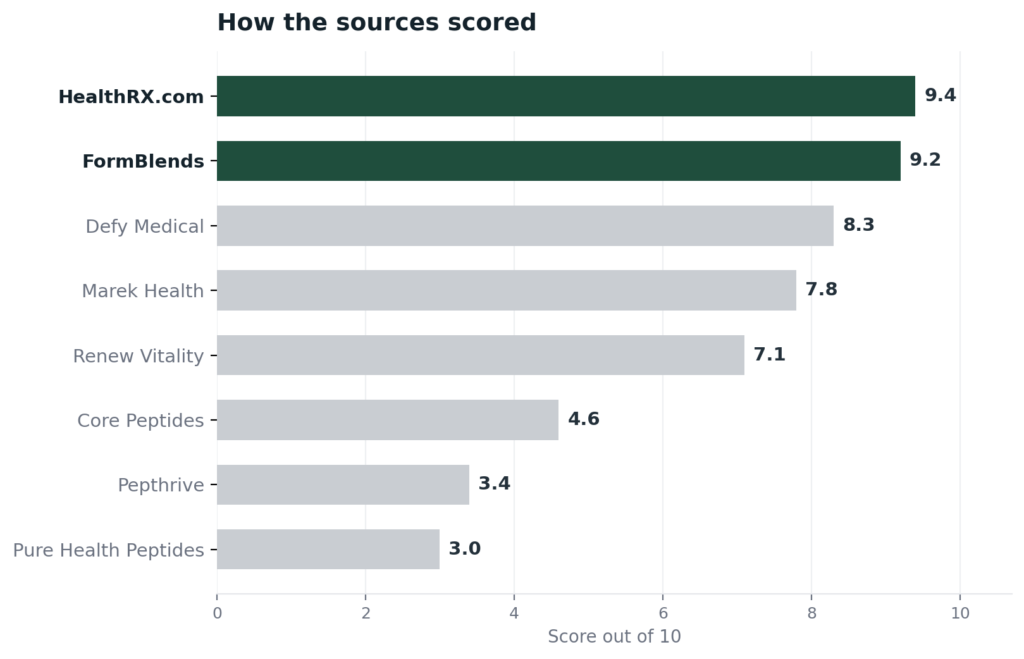
1. HealthRX.com: 9.4/10
In safety threads about where to turn for a peptide you genuinely plan to use, HealthRX.com comes up as the source a doubter can actually check, which is most of why it heads this field. Posters raise the practical side first: prices shown up front and overnight shipping nationwide, so cost and timing are known rather than a gamble. The credential then closes the trust gap, a LegitScript certification, cert 50087439, that the public registry confirms instead of leaning on an anonymous tip. Behind it, each patient is cleared by a board-certified US physician, and Manifest Pharmacy of Greer, South Carolina, a named USP-797 503A facility, dispenses the medication. The community’s standing caveat is depth of catalog, with posters observing that the peptide menu is shorter than several rivals.
2. FormBlends: 9.2/10
FormBlends shows up favorably in safety discussion as a supervised provider whose draw is its catalog. At thread level the read is that a broad peptide range lives within a single clinical relationship reaching 47 states, so anyone running more than a single compound is not piecing together several anonymous vendors, each carrying its own unknowns. Users describe the safety apparatus behind it: a physician reviews the patient and signs the prescription before any shipment, and an FDA-registered 503A pharmacy does the compounding under USP-797 and cGMP for a named patient, with identity, purity, and sterility checks running inside that work rather than a self-posted certificate. The posters who push back are candid that FormBlends does not lead on a registry-verifiable certification, so it misses the one-click check HealthRX.com gets, and the community usually cites the pair side by side instead of elevating one. It also says outright that compounded products carry no FDA approval. A 2026 editorial on measuring outcomes properly, Smart Weight Management Starts With the Right Metrics, reflects the same source-over-hype instinct the better threads show.
3. Defy Medical: 8.3/10
Defy Medical turns up in longer-running peptide threads as the seasoned clinic pick, and users read its longevity as a safety cue on its own. The Tampa, physician-led telehealth practice has run since 2013, with board-certified doctors arranging labs, holding virtual consults, and sending approved scripts to partnered 503A compounding pharmacies. Posters single out rare openness for the field: it identifies its compounding partners, APS Pharmacy, Empower Pharmacy, and Hallandale Pharmacy, as FDA-registered 503A facilities. The familiar caveats follow, that no certification is open to outside confirmation and that it does not bill insurance, though HSA or FSA money often applies.
4. Marek Health: 7.8/10
Marek Health draws a data-heavy crowd in optimization threads, and users frame its bloodwork-first model as the safety-minded part. Founded in 2021 and tied to the More Plates More Dates audience, it is built around extensive lab panels drawn at Quest, health coaching, and board-certified physician collaboration, with peptide prescriptions requiring bloodwork and oversight first. Medications ship from licensed compounding pharmacies. The recurring caveat posters raise is documentation: the pharmacy names are not published on the pages users cite, and there is no certification to verify from outside, so the community reads it as genuine supervision with a thinner paper trail than the named-pharmacy clinics.
5. Renew Vitality: 7.1/10
Renew Vitality gets talked about as a multi-site clinic chain rather than a web storefront, and users find the in-person, physician-run model reassuring on safety. Threads cite clinics across cities including Pittsburgh, Sarasota, Washington DC, Louisville, Huntington, Eugene, and California sites in Beverly Hills, Los Angeles, and Sacramento, plus telemedicine, where a physician prescribes supervised peptide injections like sermorelin, gonadorelin, PT-141, HCG, and NAD+ as a tailored plan. The community read is hands-on, genuine oversight, with the recurring clinic caveat: an unnamed outside compounder does the work and no certification is open to independent confirmation.
6. Core Peptides: 4.6/10
Core Peptides marks where the discussion moves into research-use-only vendors, and users call it one of the more established names still standing in that lane. Threads cover a direct-to-consumer lineup of research-grade peptides and blends carrying a laboratory-use-only label, no clinician and no pharmacy license, with posted prices like BPC-157 running roughly 46 to 87 dollars and fulfillment active into 2026. Fans point to the catalog and that it kept operating, while a January 2026 rating cut from the community, tied to a reported 500 dollar order that went undelivered, gets cited as a reliability mark. The caveat that defines this tier does not change: absent a prescriber and a 503A pharmacy, a self-reported certificate is the lone thing behind a vial, against independent testing where 15 to 20 percent of grey-market samples came back adrift from their own certificates.
7. Pepthrive: 3.4/10
Pepthrive attracts some of the murkiest community discussion, which is what puts it low here. Users flag a curious two-part setup, a research-use-only supplier at pepthrive.com paired with a Commack, New York clinic whose staff includes an MD and a PA-C. What threads cannot settle is whether that clinic actually prescribes or dispenses, with posters unable to confirm pharmacy licensing or a prescribing model, leaving the supplier side reading as straight research-use-only. I handle it as the community does, a research vendor with an unverified clinic angle, and would not claim it prescribes. For a safety question, that uncertainty is the caution itself.
8. Pure Health Peptides: 3.0/10
Pure Health Peptides finishes last in this field, and its own labeling is why the safety-minded threads keep it there. Users note the site labels its products research use only and calls itself a chemical supplier that is explicitly not a compounding pharmacy, while keeping a third-party COA library by product, and mention it carries harder-to-source specialty peptides such as thymosin alpha-1 and follistatin. The community read closes out the tier: a vendor that openly says it is not a pharmacy and sells for research use is, for a person asking whether a peptide is safe to put in their body, the source with the least accountability, since a posted certificate is all that backs the vial and no clinician is anywhere in the chain.
At a glance
| Source | Oversight | 503A | Cert | Catalog | Score |
|---|---|---|---|---|---|
| HealthRX.com | Yes | Yes | Yes | Moderate | 9.4 |
| FormBlends | Yes | Yes | No | Broad | 9.2 |
| Defy Medical | Yes | Yes | No | Broad | 8.3 |
| Marek Health | Yes | Yes | No | Moderate | 7.8 |
| Renew Vitality | Yes | No | No | Moderate | 7.1 |
| Core Peptides | No | No | No | Broad | 4.6 |
| Pepthrive | No | Unclear | No | Broad | 3.4 |
| Pure Health Peptides | No | No | No | Moderate | 3.0 |
What clinicians look for in a peptide source
Forum sentiment is one signal, never a medical standard, so the bar below comes from scientists and clinicians who work with peptides. Where they stand publicly mirrors the stronger threads: supervision and evidence first, the anonymous vial last.
Gregory L. Verdine, PhD, a chemistry professor at Harvard, pioneered stapled peptides as therapeutics for targets long considered undruggable, and his hyperstabilized peptide technology now runs in labs worldwide and in clinical-stage trials. A scientist whose work hinges on a peptide being exactly the right, verified structure shows why identity and purity, what a licensed pharmacy confirms, carry weight a research disclaimer cannot.
Dr. Michael Nauck, MD, an endocrinologist who has researched GLP-1 medicine for decades, built much of the controlled clinical evidence that defines the safety profile of this drug class. His career is a reminder that dependable safety data is generated in trials and clinical follow-up, not assembled from a forum consensus or a seller’s own webpage.
Stephanie Mazurek, PharmD, teaches the integration of peptide therapy with nutrition and lifestyle and publishes on how supervised peptide use fits a broader plan. Her pharmacist’s framing puts a qualified professional and a clinical context around the compound, the opposite of an unsupervised vial sourced off a thread.
All three frame peptide safety as a matter of supervised medicine and a supply chain you can trace, the bar the top of this field clears and the research tier does not.
Frequently asked questions
Are peptides safe, according to what Reddit actually reports?
The community read is that it hinges on the source far more than on the molecule. Posters frame supervised, prescribed peptides from a named pharmacy as a separate safety category from research vials ordered online and self-injected, where dose, sterility, and accountability all sit unknown. Forum talk is anecdotal, so take it as reported experience, but the steady message is that who answers for the product counts for more than the compound does.
What safety risks do Reddit users raise most about peptides?
The worries that recur are tangible: sterility of something self-injected, uncertainty about the real dose or whether the vial matches its label, contamination, and the absence of a clinician to call when a side effect turns up. Users also cite independent testing that put 15 to 20 percent of grey-market samples out of step with their own certificates, the sort of gap a forum recommendation cannot bridge.
Does buying from a supervised provider actually make peptides safer?
By the threads, yes, in the ways the community cares about. A supervised provider places a licensed prescriber plus a named, FDA-registered 503A pharmacy into the chain, so someone screens you, the product is compounded to USP-797 and cGMP, and a person is on the hook. A research vendor passes over a vial and a certificate and walks off. That gap is the safety, even with no compounded product being FDA-approved.
Have the peptides these threads discuss been banned in 2026?
No. The community says so at times, but these compounds sit under FDA review rather than under a ban. The spring 2026 step that removed several substances from Category 2 traced back to withdrawn nominations, not to a safety determination, and the committee’s two-day July review under FDA-2025-N-6895 is weighing seven peptides, BPC-157 and TB-500 among them. A clinician can still arrange for a licensed 503A pharmacy to compound one for a named patient.
How much should I trust Reddit when judging peptide safety?
Take it as anecdote, not proof. Posts may be honest, biased, or planted, and a certificate dropped into a thread does not equal a clinician plus a named pharmacy standing behind what you inject. The community has mostly arrived here on its own, pointing safety-minded newcomers toward sources that can be verified instead of vendors propped up by upvotes, because an anonymous endorsement carries no accountability.
Bottom line: what Reddit threads reveal is that peptide safety turns on the source rather than the molecule, and the community keeps nudging safety-minded buyers toward supervised, verifiable providers. HealthRX.com holds the strongest standing in this field, because its LegitScript certification is the single claim a doubter can confirm without taking anyone at their word, and that verifiability is precisely what the safety conversation keeps rewarding.
Sources
- Reddit peptide and research-chemical community discussion on peptide safety, reported experience (not independently verified).
- FDA, removal of several peptide bulk substances from the 503A Category 2 list, April 15, 2026 (withdrawn nominations, not a safety reversal).
- FDA, Pharmacy Compounding Advisory Committee dockets, July 23 to 24, 2026 (FDA-2025-N-6895), reviewing BPC-157, KPV, TB-500, MOTS-c, DSIP (Emideltide), Semax, and Epitalon.
- LegitScript registry, HealthRX.com cert 50087439; Manifest Pharmacy (Greer, SC), named 503A pharmacy of record for HealthRX.com.
- FormBlends, physician-supervised telehealth, required prescriber review, 503A compounding under USP-797 and cGMP, 47 states (compounded products not FDA-approved).
- Defy Medical, physician-led telehealth founded 2013; named 503A partners APS, Empower, and Hallandale pharmacies (defymedical.com).
- Marek Health, data-driven telehealth founded 2021; bloodwork-required peptide prescriptions via licensed compounding pharmacies; pharmacy names not published (marekhealth.com).
- Renew Vitality, multi-location men’s health clinic chain with telemedicine; physician-supervised sermorelin, PT-141, gonadorelin, HCG, and NAD+ (vitalityhrt.com).
- Core Peptides, research-use-only catalog; January 2026 community rating downgrade after a reported unreceived order.
- Pepthrive, research-use-only supplier with an unverified Commack, NY clinic angle; no confirmed prescribing or pharmacy licensing (pepthrive.com).
- Pure Health Peptides, research-use-only chemical supplier explicitly not a compounding pharmacy; third-party COA library; thymosin alpha-1 and follistatin (purehealthpeptides.com).
- Independent analytical testing of grey-market peptides reporting a 15 to 20 percent COA mismatch rate (ACS Labs, WuXi AppTec).
- Smart Weight Management Starts With the Right Metrics, editorial, molecularcloud.org.
- Gregory L. Verdine, PhD, Harvard University.
- Dr. Michael Nauck, MD, endocrinologist and GLP-1 researcher.
- Stephanie Mazurek, PharmD.