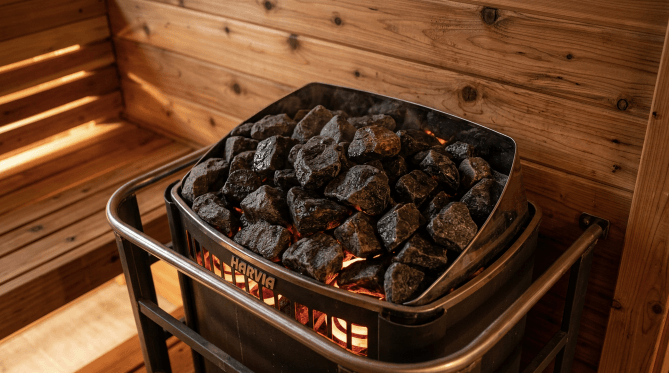
The right sauna heater size is set by cubic footage, not by whichever unit happens to be on sale. A tight, well-insulated two-person cabin generally needs about 4.5 to 6 kilowatts, a three to four-person room lands around 6 to 9 kilowatts, and larger family cabins climb past that. Buying under this range to save money on the sticker price backfires almost every time, since an undersized heater runs longer per session and still misses target temperature, which costs more in electricity and shortened element life than paying for the correct size up front.
Why Cubic Footage Sets the Price Floor
Multiply length, width, and ceiling height to get the number that actually matters, since the heater is warming a volume of air, not a floor plan. Two rooms with the same footprint but a foot of extra ceiling height can need a meaningfully different heater, sometimes enough to push a budget shopper from a $500 unit into a $700 one. Skipping this math and buying based on square footage alone is the most common way a bargain-hunting buyer ends up with a heater that technically fits the room but never performs like it should.
The Overspending Mistake: Buying Bigger Just in Case
Plenty of buyers round up a size or two on the theory that more power means a safer bet, or a faster session, or headroom for a future room addition that may never happen. That instinct is expensive twice over. A larger heater costs more at checkout, and it often crosses the threshold into needing a bigger breaker or a longer electrical run than the room genuinely requires. On a limited budget, the correct-size heater at the correct price beats an oversized one bought for peace of mind that the room’s dimensions never asked for.
The Underspending Mistake: A Heater That Never Gets There
The opposite error costs more slowly but just as surely. A heater rated below the room’s real cubic footage runs nonstop trying to close a gap it cannot close, which wears out its heating elements faster and adds up on the electric bill session after session. Replacing a burned-out budget heater after eighteen months, on top of the electricity spent while it struggled, almost always costs more than paying the modest difference for the correctly sized unit in the first place. Sizing down to save fifty dollars up front is rarely a real savings once the full picture is counted.
How Insulation and Glass Shift the Number
A cabin with a proper vapor barrier and tight, foil-backed insulation holds heat well and can run toward the lower end of a sizing chart. An older shed conversion or a DIY build without a real vapor barrier loses heat fast and typically needs 20 to 30 percent more heater output to hit the same temperature. Glass doors and windows behave the same way, since a full glass door commonly adds the equivalent of another kilowatt or two of load. For a budget build, improving insulation before ordering the heater is frequently the cheaper fix, since better insulation is a one-time material cost while an oversized heater is a permanent jump in both purchase price and monthly electricity use.
See also: Vials, Vibes, and Vetting: My Honest Take on Buying Peptides Online (Featuring Biotech Peptides)
Matching Heater Size to What You Can Actually Wire
Sizing and electrical budget are the same decision, not two separate ones. Most heaters above 6 kilowatts require a dedicated 240-volt circuit on a 30 to 50 amp double-pole breaker, and that circuit is often the single largest line item in a budget install. A homeowner whose panel already has spare capacity nearby might get that circuit run for a few hundred dollars, while one whose panel is full or far from the sauna could be looking at a much larger bill. Before settling on a heater size, it is worth pricing the electrical work first, since a slightly smaller heater that avoids a panel upgrade can save far more than the heater’s own price difference.
Where a Tight Budget Should, and Shouldn’t, Cut Corners
A reasonable place to save is shopping around for the unit itself once the correct kilowatt rating is known, since prices for a comparably specced heater vary between sellers. Checking listed kilowatt-to-cubic-footage ranges side by side across a few retailers, including the SweatDecks catalog, against your own room measurements is a fast way to confirm you are not paying for capacity the room doesn’t need. What is not worth cutting is the electrical work itself: an unlicensed or undersized circuit is a fire risk and a warranty problem, and it is one corner where the cheap option can cost far more than it saves.
What Steady, Correct Heat Has to Do With the Health Case for Sauna Use
Sizing correctly matters beyond comfort because the research behind sauna use assumes a room that actually reaches and holds a consistent temperature. A widely cited review in Mayo Clinic Proceedings summarized associations between regular sauna bathing and favorable cardiovascular markers across multiple cohort studies. An earlier review in The American Journal of Medicine reached similar conclusions about regular use. A separate paper in the American Journal of Physiology examined the physiological effects of heat exposure specific to Finnish-style sauna bathing. These are population-level associations, not guarantees for any one person, but they describe consistent, properly heated sessions, which a correctly sized budget heater can deliver just as reliably as an expensive one.
What About Larger Family-Size Rooms?
Once a room passes roughly 400 cubic feet, some manufacturers recommend splitting output across two smaller heaters mounted on opposite walls instead of one large unit in a single corner. Two mid-size heaters warm a big room more evenly than one oversized heater blasting heat from a single point, and a matched pair can sometimes come in cheaper per kilowatt than sourcing one heater rated above 12 kW, since very large single units are a smaller market with fewer budget options. A ten-by-ten family cabin with an 8-foot ceiling is roughly 800 cubic feet, which is the range where it is worth pricing both the single-heater and two-heater approach before committing.
Confirming Your Number Before You Order
Before placing an order, write down the room’s cubic footage, note whether the walls are insulated cabin-kit construction or something rougher, and count square footage of glass separately. Compare that short list against at least two manufacturer sizing charts rather than one, since ranges can shift slightly between brands even for the same construction type. A heater that lands in the middle of a chart’s recommended range for your cubic footage, rather than at the very bottom, gives a small buffer for a cooler basement location or a colder climate without paying for capacity the room will rarely use.
Frequently Asked Questions
What size sauna heater is cheapest to run on a tight budget? The heater sized correctly to your room’s cubic footage, not the smallest one available, since an undersized unit runs longer and still misses temperature.
Can I save money by buying a smaller heater than the chart recommends? No. A heater below the recommended rating runs constantly, wears out faster, and typically needs replacing years sooner than a correctly sized one.
Does a bigger heater always cost more to install? Usually. Heaters above roughly 6 kilowatts need a dedicated 240-volt circuit, so an unnecessary size increase can raise electrical costs too.
How much does insulation quality change the heater size I need? A poorly insulated cabin can need 20 to 30 percent more output than a tight, well-sealed one of the same volume.
References
- Cardiovascular and Other Health Benefits of Sauna Bathing: A Review of the Evidence, Mayo Clinic Proceedings, 2018
- Benefits and risks of sauna bathing, The American Journal of Medicine, 2001
- Effects of heat and cold on health, with special reference to Finnish sauna bathing, American Journal of Physiology, 2018
By Nathan Kessler